
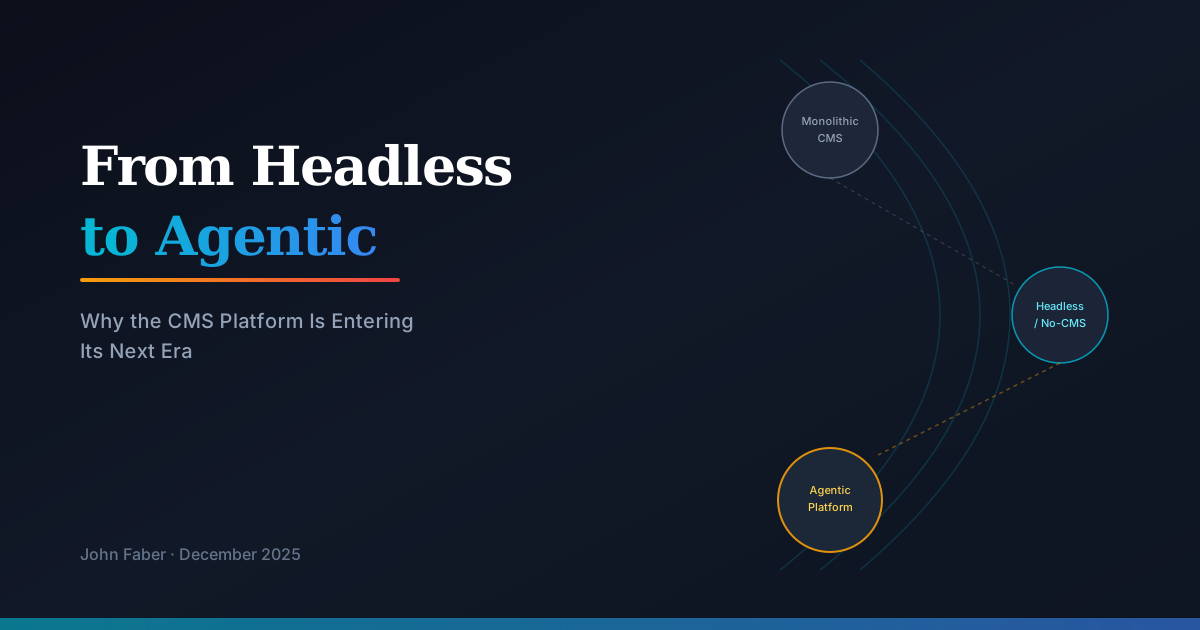
The CMS industry is once again at an inflection point.
Over the last decade, I have watched digital platforms swing dramatically from monolithic CMSs to fully decoupled headless architectures, and now toward AI-driven, no-CMS experiments. Each shift promised speed and flexibility. Each also introduced new forms of complexity.
A recent blog exchange between Lee Robinson and Sanity.io crystallizes this moment perfectly — not as a debate, but as a signal that the industry is ready for its next evolution.
The Case for "No CMS" — and Its Limits
In a widely discussed post, Lee Robinson documented why he walked away from a Sanity-powered headless CMS implementation and rebuilt his site using AI agents and markdown files stored directly in Git.
His reasoning was clear and compelling:
- Headless architectures introduce real operational overhead
- API orchestration, frontend frameworks, and content pipelines add friction
- For developer-led teams, AI agents and flat files can be fast, flexible, and surprisingly effective
The result is impressive. For teams with strong engineering resources, this approach enables rapid iteration with minimal infrastructure.
But the success of this experiment also exposes its constraint.
A markdown-and-Git workflow assumes ongoing access to talented developers. It removes editors, marketers, and content teams from the equation entirely. At scale, that tradeoff becomes unsustainable for most organizations.
The Headless CMS Defense — and Its Own Friction
Sanity's response was equally telling. Their argument was not that Lee's approach doesn't work, but that it doesn't scale.
They're right.
Most organizations need:
- Structured content models
- Editorial workflows
- Governance, permissions, and approvals
- Non-developers who can safely publish and manage content
However, the defense of headless CMSs often overlooks the very friction Lee describes. API-first platforms still require a separate frontend application, ongoing framework maintenance, and deep technical expertise to evolve the system over time.
In practice, many teams end up managing multiple stacks, multiple vendors, and multiple sources of truth — creating exactly the kind of technical fatigue modern platforms were supposed to eliminate. The Next-Drupal project experienced this exact friction. Technical fatigue and cost slowed adoption.
The Real Insight: This Is Not a Binary Choice
What both perspectives reveal is something more important than what is "right."
The problem isn't headless CMSs. It isn't markdown. It isn't AI agents.
The problem is fragmentation.
Organizations don't want to choose between:
- Speed or governance
- Developers or editors
- AI innovation or operational stability
They want a platform that brings all these forces together.
What a Modern CMS Platform Must Be
To move at the speed of now, digital teams require a platform that:
- Deploys quickly and scales across multiple sites
- Provides strong content modeling and governance
- Empowers editors with modern, component-based page building
- Integrates AI agents directly into content and site operations
- Reduces architectural sprawl instead of increasing it
- Runs on enterprise-proven, secure infrastructure
In other words, the CMS can no longer be just a hosted content repository. It must be a unified managed platform.
Enter the Next Generation of CMS Platforms
This is where my thoughts shift from reaction to evolution.
Acquia Source — a new class of platforms — is emerging to address the gaps exposed by headless, no-CMS, and monolithic approaches alike.
Built on Drupal's mature content modeling and governance capabilities, and reimagined with AI-first workflows, Acquia Source brings together:
- Structured content and editorial control
- Visual, component-based site building
- Open, extensible AI agents that assist — not replace — teams
- Centralized governance across multiple sites
- Enterprise-grade hosting and security by default
Rather than eliminating the CMS, this approach modernizes it by aligning speed, intelligence, and control within a single platform.
The CMS Pendulum Is Settling
Our industry has spent years swinging between extremes. What I am seeing now is the pendulum slowing down and settling.
The future isn't headless versus monolithic. It isn't CMS versus AI. It isn't developers versus editors.
The future is integrated platforms that reflect how organizations actually work.
If you are interested in talking about how Acquia Source can help your business or agency, feel free to reach out.