
Chapter Three introduced Next-Drupal three years ago, and it quickly gained popularity. This innovative solution offers a robust technical path to decouple your Drupal site without sacrificing the daily features that editors require. While Next-Drupal has numerous benefits, many decision-makers still question: "Why should I use a decoupled front-end when Drupal works fine?"
In this post, we explore a compelling reason to consider decoupling your Drupal site, with a specific focus on the significant return on investment (ROI) it can yield. In today's fiercely competitive market, the value a website brings to a business is under intense scrutiny. With AI consuming budgets traditionally allocated for websites, decision-makers are actively seeking ways to reduce costs and enhance ROI. Decoupling your Drupal site with Next-Drupal is a strategic move in this direction.
The Cost of Running a Large Drupal Site
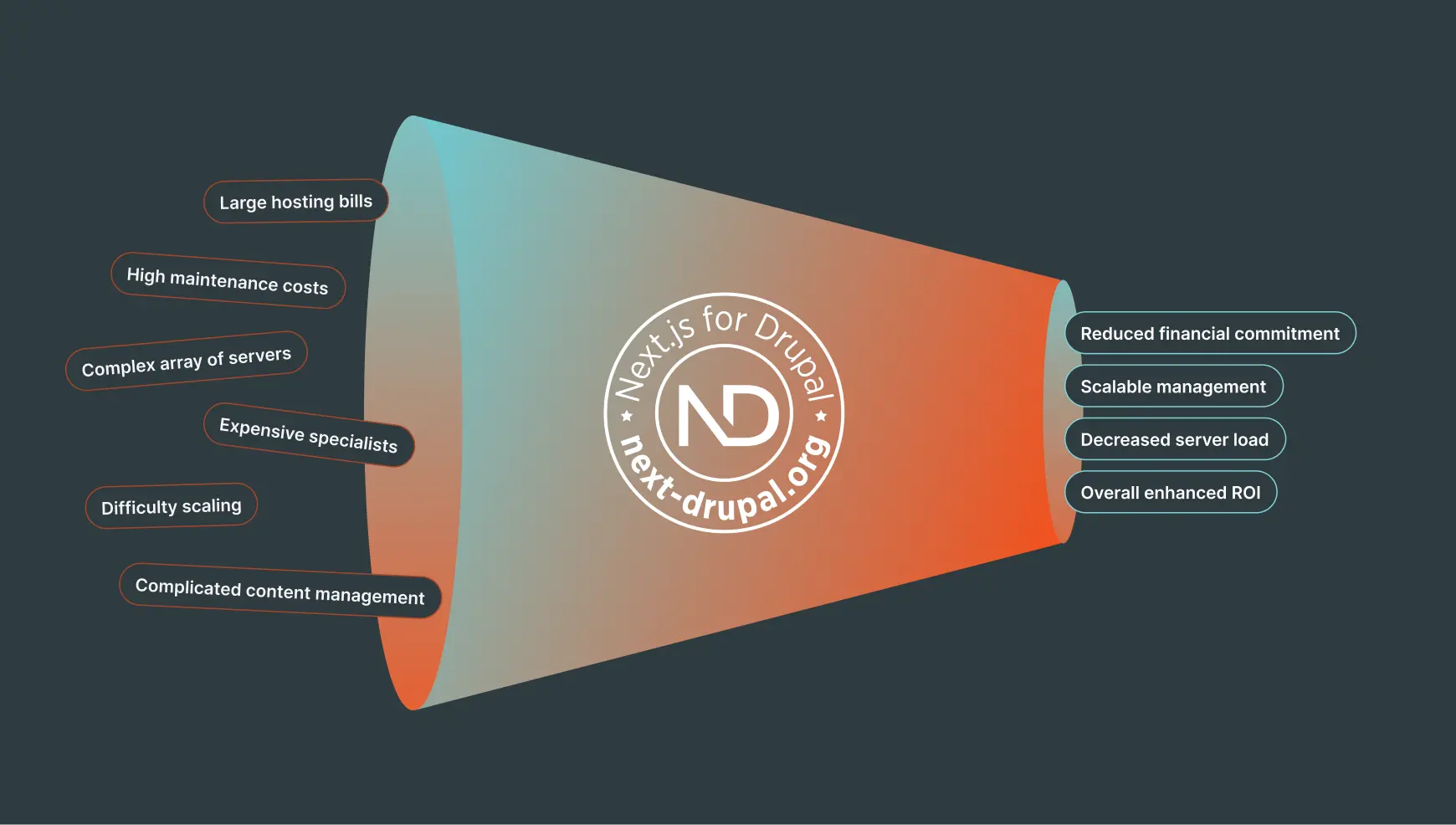
Managing a large Drupal site can be a significant financial commitment. The hosting platform and the need for specialized Drupal developers are the primary cost drivers. The adoption of Next-Drupal, however, can lead to a substantial reduction in these costs. By decoupling your Drupal site with Next-Drupal, you can significantly reduce your financial commitment to the platform and specialized developers, freeing up resources for other business needs.
Traditional Drupal hosting typically involves a LAMP stack, which is straightforward but challenging to scale with increasing traffic. Specialized Drupal hosting companies developed managed platforms to address this, but the costs grew exponentially as projects became more ambitious. Rendering the Twig template front-end at scale requires considerable resources, making scaling a LAMP stack application resource-intensive.
How Next-Drupal Changes the Equation
Next-Drupal separates the back-end and front-end, leveraging Drupal's open-source, API-first content management capabilities and Next.js's lightweight, popular React framework. This technical setup allows for more efficient and scalable management of your Drupal site, potentially reducing the need for extensive server resources and specialized hosting solutions.
Despite initial skepticism, the financial benefits of decoupling with Next-Drupal are now undeniable.
A Real-World Result: 65% Hosting Cost Reduction
A recent success story from Chapter Three involved upgrading a large site from Drupal 7 to Drupal 10 using Next-Drupal. This high-traffic site — with logged-in users and traffic spikes during news events — requires a robust platform and network. The Drupal 7 site was hosted and managed internally on a complex array of servers to handle the load, resulting in significant IT costs for hardware and maintenance.
During this project, we eliminated internal servers and moved to a composable platform. The server load for Drupal was reduced significantly by decoupling the site. The result?
This organization reduced its hosting costs by an astounding 65%.
On the composable stack, Drupal only requires a small amount of server power — just one server is required for editors to create and manage content. Vercel serves the Next.js front-end of the site using bandwidth as a central metric for site usage. The Next.js templates use Drupal's API system to fetch and render data. Next-Drupal templates are lightweight and don't use a lot of bandwidth, even in high-load situations.
No more "page-view" bills.
The Bottom Line
Using Next-Drupal and moving to a composable hosting stack will reduce your website's overall hosting costs. Given the many other benefits of a decoupled approach, it's worth investigating how you can optimize your web ecosystem.
If you are interested in learning more, contact us. We would be happy to help.